
Complete engineering guide covering black oxide process, specification parameters, DFM checklist, and selection guide for steel CNC prototypes and small-batch production.
In One Sentence
Black oxide conversion coating is specified for precision steel CNC prototypes & small batches when near-zero dimensional shift, matte black appearance, and low-cost indoor light corrosion protection are required.
📱 **Mobile users: swipe left/right to view full table.**
1. Why Engineers Specify Black Oxide Finish
Core Unique Advantages of Black Oxide
- Negligible dimensional change: 0.5–1.5μm total thickness gain, no tolerance compensation needed for standard ±0.01mm tolerances
- Uniform matte black non-reflective surface, ideal for optical measurement fixtures, lab tooling
- Improves surface lubricity for sliding, threaded assembly
- Low cost surface treatment for small batch prototypes (1–50pcs)
- RoHS compliant, no heavy metal plating contamination risk
- Adheres tightly, no chipping, peeling or flaking like powder coating
When to Choose Black Oxide
| Scenario | Why Black Oxide Fits |
|---|---|
| Precision tight-fit steel components | Near-zero dimensional shift preserves thread, bore & shaft tolerances |
| Indoor lab, automation, mold tooling | Matte anti-glare finish, light rust protection with supplementary sealant |
| Small batch prototypes & low-volume custom CNC parts | Fast turnaround, affordable finishing without complex pre-work |
| Parts requiring secondary lubrication during assembly | Porous oxide layer holds oil/wax lubricant |
| Non-outdoor, non-marine dry operating environments | Balanced cosmetic & basic corrosion performance |
Critical Limitations
- Bare black oxide (no sealant) rusts quickly under humidity; all parts require oil / dry wax sealing
- Poor corrosion resistance for outdoor, coastal, high-humidity long-term storage
- Cannot hide machining tool marks, pits or surface scratches; base Ra fully visible
- Not suitable for high-wear continuous motion components (choose black zinc / manganese phosphate instead)
2. Key Specification Parameters — And Why They Matter
| Parameter | Specified Information | Why it matters |
|---|---|---|
| Base substrate | Carbon steel / alloy steel / stainless steel grade + heat treatment state | Different steel families require separate black oxide bath processes (MIL-DTL-13924 Class 1/2/4) |
| Governing standard | MIL-DTL-13924 Class X / AMS 2485 | Eliminates supplier process ambiguity from generic “black finish” notes |
| Supplementary sealant | Light machine oil / dry touch wax / lacquer | Determines salt spray life & air express anti-rust performance |
| Masking requirements | Threads, precision bores, sealing datums, contact faces | Prevents oxide buildup altering critical fit tolerances |
| Film thickness & material removal | Max 1.5μm growth allowance | Guarantees post-finish dimensions match drawing tolerance |
| Appearance acceptance | Color range, gloss, permitted rack contact marks + signed sample | Resolves cosmetic disputes for prototype small batches |
| Certification requirements | Batch COA, salt spray test report, FAI inspection record | Meets audit needs for semiconductor, medical, aerospace prototypes |
3. CNC Machining Characteristics and Boundaries
How Black Oxide Impacts Machined CNC Features
| Feature | Process Planning Considerations |
|---|---|
| Precision thin walls & slender shafts | Avoid heavy rack clamping; full oven drying after sealing to prevent deformation |
| Internal threads, fine pitch holes | Mask all functional threads; unmasked threads risk gauge tightness after oxidation |
| Sealing surfaces & datum planes | Mark non-process zones on masking drawing; oxide film will break liquid-tight sealing performance |
| Deep blind holes & cross bores | Add drain holes; trapped bath residue causes white mottling during international courier transit |
| Sharp edges & micro fillets | Min sharp radius ≥ R0.2; sharp corners accumulate excess oxide and appear dark/rough |
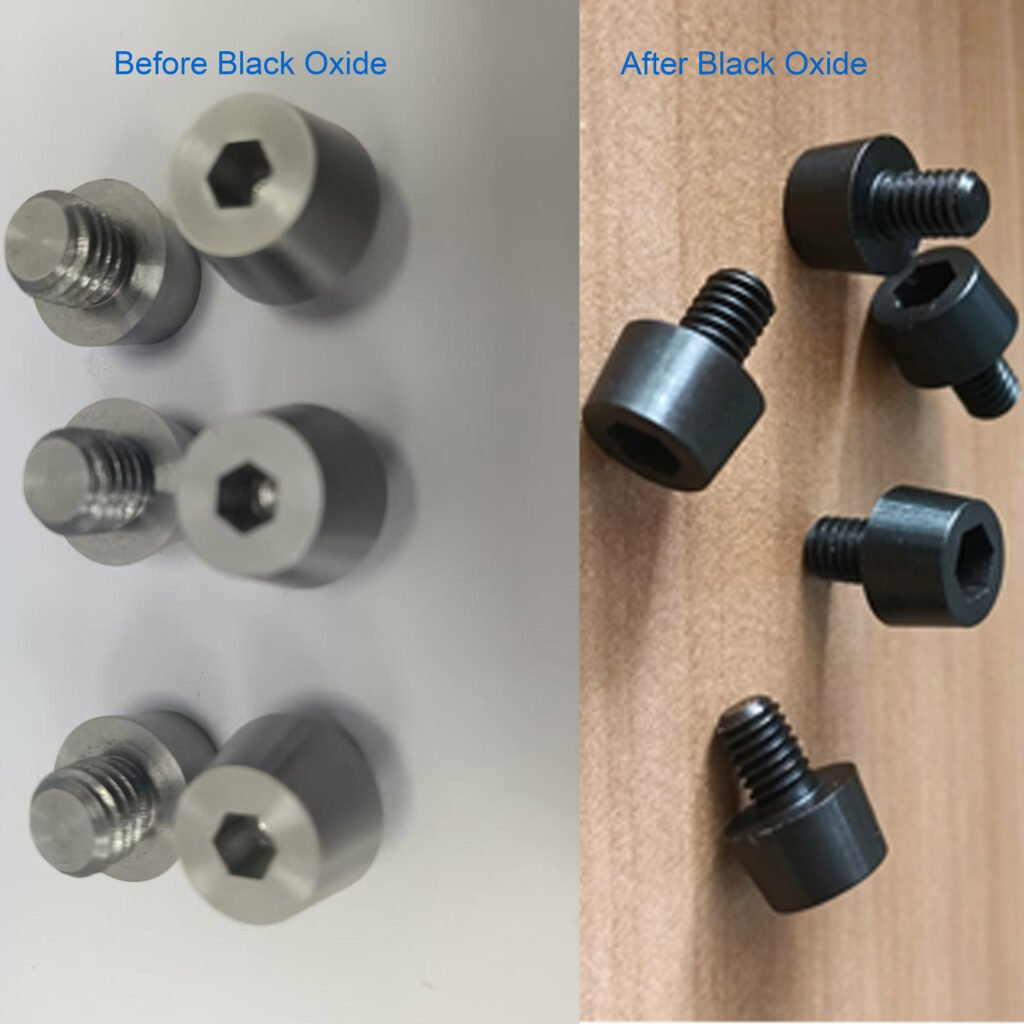
Before & after black oxide finish with light oil seal on C45 steel screws
Non-Negotiable Manufacturing Risks for Small Batch CNC Parts
- Thermal humidity during air express transit: Unsealed / oil-only parts form flash rust inside DHL/FedEx cargo holds
- Batch color inconsistency: Small 1–10pc prototype runs create rack contact marks; pre-production signed sample mandatory
- Abrasive pre-machining defects: Sandblasting, heavy tool scratches remain visible after black oxide
- Stainless steel compatibility: Standard hot black oxide baths fail stainless grades; dedicated mid-temp process required
- Rework restriction: Full strip & re-machining required for defective finish; thin prototypes risk dimensional loss
4. Typical CNC Applications & Finished Precision Parts
Industry Usage Table
| Industry | Typical Black Oxide CNC Components | Core Requirement |
|---|---|---|
| Automation & Tooling | Fixture plates, tool holders, guide pins, clamping blocks | Low glare, tight tolerance retention, low cost small batch |
| Semiconductor Lab Equipment | Wafer handling jigs, internal chamber steel brackets | Non-reflective, clean dry wax seal (no oil contamination) |
| Mold & Die Making | Mold support plates, ejector pins, low-load inserts | Consistent matte black appearance, basic indoor rust resistance |
| General Precision Machinery | Fasteners, bushings, spacers, manual adjustment knobs | Thread dimensional stability, light lubrication retention |
| Medical Laboratory Devices | Non-implant steel test fixtures | Clean dry wax seal, RoHS compliant, no oil residue |
Mecore Real-World Machined Black Oxide Parts
- Precision 1.1730 / C45U fixture plates with masked H7 bores
- Carbon steel threaded spacer prototypes (1–10pcs small batch)
- Low-wear tool holders with dry wax sealing for international air express
- Semiconductor non-reflective steel clamping brackets
Industry-Specific Attention Point
Black oxide for semiconductor cleanroom prototypes demands dry wax sealing and full VCI individual packaging for courier shipping; general machinery tooling can use low-cost oil seal. Application environment and sealing type must be clearly stated on drawings, not inferred from geometry.
5. Material Compatibility Quick Reference Table
| Substrate Grade | Black Oxide Suitability | Process Notes | Typical Use Case |
|---|---|---|---|
| Low/Medium Carbon Steel (1018, 1045 / 1.1730 C45U) | Excellent (MIL-DTL-13924 Class 1) | Uniform deep black finish, stable film | General fixture, mold frames, small batch prototypes |
| Alloy Steel (4140, 4340, 8620) | Good (Class 2) | Full acid descaling required to avoid blotching | Heat-treated tooling, high-strength shafts |
| Martensitic Stainless (410, 420, 17-4PH) | Limited (Class 4 mid-temp process) | Special activation bath, longer processing time | Anti-glare lab & semiconductor hardware |
| Austenitic Stainless (304/316) | Poor compatibility | Standard black oxide cannot break passive chromium layer | Avoid black oxide; choose passivation instead |
6. Processing and Design Pitfalls
| Common Pitfall | Potential Result | Practical Engineering Response |
|---|---|---|
| Drawing only marks “Black Oxide” without sealant spec | Parts shipped bare/oiled, flash rust during DHL/FedEx transit | Explicitly write oil / dry wax seal on drawing general notes |
| Unmasked precision threads & sealing faces | Pitch diameter shifts, poor sealing performance | Attach separate masking map for all critical functional surfaces |
| No pre-production signed cosmetic sample | Batch-to-batch color variation disputes on small prototypes | Mandatory sample approval for all orders under 50 pieces |
| Insufficient oven drying before sealing | Trapped bath moisture causes white mottling defects | Specify minimum 120℃ 30min post-process bake on RFQ |
| Over-reliance on black oxide for outdoor corrosion | Rapid rust failure in high humidity | Switch to black zinc plating for exposed operating parts |
| Rough pre-machined surface Ra >3.2μm | Uneven, patchy black appearance | Define max pre-finish Ra requirement on drawing |
7. Design-for-Manufacturing Checklist
☐ Specify full substrate grade + heat treatment state (e.g. 1.1730 C45U normalized, 4140 tempered)
☐ Define black oxide standard & class: Black Oxide per MIL-DTL-13924 Class X
☐ Clarify supplementary sealant: Light oil seal / dry touch wax (for air express prototypes)
☐ Attach masking drawing for threads, precision bores, datums and sealing faces
☐ Confirm whether all drawing dimensions apply after black oxide finishing
☐ Limit tight GD&T tolerances only to functional surfaces; non-critical features relaxed
☐ Specify surface roughness limit before finishing (max Ra 1.6μm for uniform black finish)
☐ Lock cosmetic zones, viewing conditions and signed physical sample for appearance control
☐ State required documentation: Material COA, black oxide process certificate, salt spray test report
☐ Mark international air express packaging requirements: Individual VCI bubble wrap protection
8. RFQ Guide
To help Mecore provide you with an accurate quote quickly, the following information is required for black oxide CNC projects:
Basic Information
- STEP 3D CAD file + controlled 2D PDF drawing with full tolerances & masking annotations
- Full steel material grade, heat treatment condition, material substitution limits
- Order volume: Prototype (1–10pcs) / Small batch (10–50pcs) / Mass production
- Repeat order expectations & lead time requirements
Technical Requirements
Critical datums, thread fits, bore tolerances, flatness and surface roughness
Black oxide process specification (reference: MIL-DTL-13924 class or equivalent industrial standard) and sealing type
Masking scope, pre-finish surface preparation rules
Required inspection records, salt spray testing, and batch traceability information — heat treatment certificates available from material suppliers; process batch traceability (e.g., material lot numbers, treatment batch IDs) subject to supplier capability
Logistics Requirements
- Courier delivery type: DHL / FedEx / UPS international air express
Anti-rust packaging: rust-preventive oil + protective wrapping (PE film, bubble wrap, or ziplock bags) + plastic compartment boxes (various sizes for precision parts) + corrugated cartons — packaging method selected based on part geometry, surface sensitivity, and quantity
- Cleaning, labeling, export packing list & commercial invoice document needs
If some technical details are not finalized, send your existing drawings first; our engineering team will follow up to clarify all black oxide specifications before quotation.
Combined CAD + drawing submission allows Mecore to flag masking, dimensional and cosmetic risks before production.
9. Black Oxide vs Other Black Surface Finishes Comparison Table
| Finish Type | Film Thickness | Salt Spray (Sealed) | Dimensional Shift | Relative Cost | Best For Small Batch Air Express Prototypes | Not Recommended |
|---|---|---|---|---|---|---|
| Black Oxide | 0.5–1.5μm | 24–72h (Dry Wax) | Negligible <2.5μm | Low | Precision threaded fits, anti-glare lab fixtures | Outdoor, marine, high-humidity long storage |
| Black Zinc Plating | 8–15μm | 72–200h | Obvious thickness gain | Medium | Exposed structural hardware, low-precision fasteners | Micron-level sliding mating components |
| Manganese Phosphate | 3–10μm | Low | Moderate growth | Low | Lubricated friction parts, pre-paint base | Uniform matte black cosmetic prototypes |
| Black Electroless Nickel | 5–20μm | 500h+ | Significant thickening | High | High-corrosion lab test equipment | Budget prototype small batches |
10. International Air Express Anti-Rust Packaging Standard
- Post-black oxide full oven bake at 120℃ for 30 minutes to eliminate trapped micropore moisture
- Sealant selection guidance
- Dry wax seal (Recommended for air courier): Touch-dry, zero oil residue, ideal for electronics/semiconductor assembly, 48–72h salt spray
- Light machine oil seal (Cost-saving): Slight oily surface, wipe clean before assembly, 24–48h salt spray
- Individual piece protection: Every component wrapped in bubble film, sealed independent VCI anti-rust bag to avoid friction scratches
- Outer carton: Double-wall corrugated box with foam filling to eliminate shifting during courier sorting
Drawing Note Template for Express Orders
BLACK OXIDE SURFACE FINISH; SUPPLEMENTARY PRESERVATIVE: DRY WAX (FOR AIR EXPRESS); MASK ALL THREADS & H7 SEALING BORES AS DRAWING MASK MAP; VCI INDIVIDUAL PACKAGING FOR DHL; POST-FINISH DIMENSIONS TO MEET DRAWING TOLERANCE
Frequently Asked Questions
1. Does black oxide alter CNC part dimensions?
Only 0.5–1.5μm total film growth, negligible for standard CNC tolerances ±0.01mm. Critical ultra-tight fits still require masking or pre-process dimensional compensation confirmation.
2. Can you process black oxide for 1–5pcs prototype small batches?
Yes, we support single-piece custom CNC + black oxide finishing. Small volume runs carry minor rack mark risks; we require a signed pre-production sample to lock appearance before full processing.
3. Will black oxide parts rust during DHL air express transit?
Oil-only sealed parts may develop light flash rust under high-temperature cargo hold conditions. Dry wax + full VCI individual packaging eliminates rust risk for 3–7 day courier transit cycles.
4. Can black oxide hide CNC machining marks or surface pits?
No. Black oxide faithfully replicates all surface topography; rough tool marks, scratches and porosity will remain fully visible after finishing.
5. Can I machine parts after black oxide treatment?
Light deburring is possible, but any significant machining will remove the oxide layer and require re-finishing; standard workflow: CNC machine all geometry first, then black oxide finish.
References
Editorial Note
This document is educational content only, not a binding material or finishing specification. All process parameters, performance data and supplier capability statements require full technical review before production release.
Need a quote or free DFM engineering review for your black oxide CNC steel prototypes?
Send your 2D drawings & STEP 3D files to our team — we’ll respond within 24 hours with a competitive quote, masking recommendations and air express anti-rust packaging suggestions to avoid transit rust & cosmetic defects.