
Complete engineering guide covering PEEK engineering plastic CNC machining, including material properties, industry applications, machining challenges, and design considerations for precision CNC machined parts.
In One Sentence
PEEK Engineering Plastic is selected when engineers need high temperature capability, chemical resistance, fatigue performance, and low mass for demanding non-metallic parts.
📱 **Mobile users: swipe left/right to view full table.**
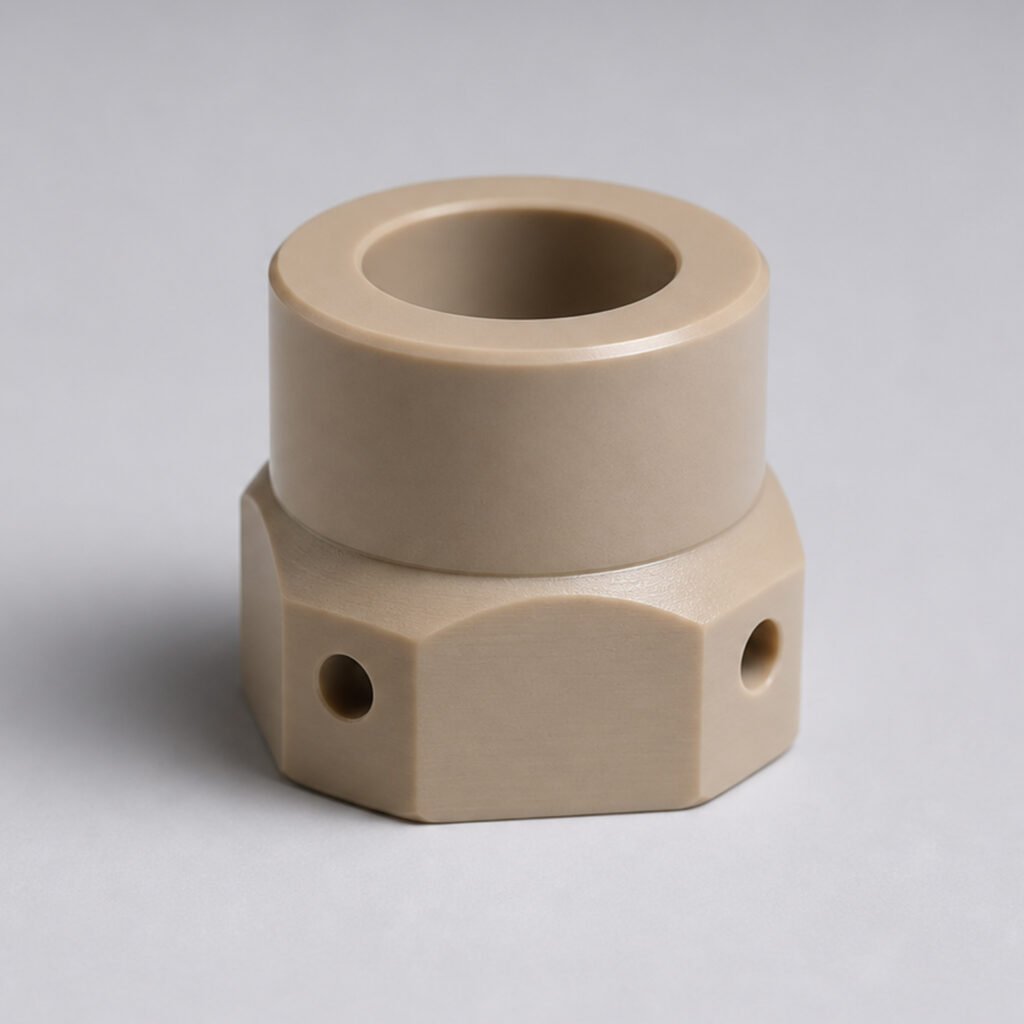
Illustrative reference only — not certified material documentation or dimensional inspection records.
1. Why Engineers Choose PEEK
Why PEEK stands out
- High temperature capability: PEEK maintains mechanical strength up to 250°C continuously, with a melting point of approximately 343°C and a glass transition temperature of 143°C. For short-term use, it can withstand even higher temperatures.
- Chemical resistance: PEEK resists attack by most acids, bases, and organic solvents — a critical attribute for semiconductor equipment components exposed to aggressive chemicals.
- Mechanical strength: With tensile strength up to 100 MPa (depending on grade and processing), PEEK offers strength comparable to many metals — a key reason it is often considered a metal replacement.
- Low moisture absorption: PEEK absorbs less than 0.5% water by weight, ensuring dimensional stability in humid or wet environments — important for precision components in semiconductor and medical applications.
- Excellent fatigue resistance: PEEK withstands cyclic loading without premature failure — suitable for components subjected to repeated mechanical stress.
- Good electrical insulation: PEEK provides high dielectric strength and volume resistivity, making it an ideal material for electrical insulators and semiconductor handling components.
- Low outgassing: In vacuum environments, PEEK releases minimal volatile compounds — a critical property for semiconductor and aerospace applications where contamination must be avoided.
When to choose PEEK
| Scenario | Why PEEK fits |
|---|---|
| High-temperature service | Continuous operation up to 250°C |
| Chemical exposure | Resists acids, bases, solvents |
| Lightweight components | Low density compared to metals |
| Semiconductor cleanroom | Low outgassing, non-contaminating |
| Electrical insulation | High dielectric strength |
| Long-term reliability | Excellent fatigue resistance |
2. Key Material Parameters — And Why They Matter
| Parameter | Specified information | Why it matters |
|---|---|---|
| Material designation | Polyether ether ketone (PEEK) — grade to be confirmed per application | Prevents purchasing or heat-treatment substitution errors |
| Material family | High-performance thermoplastic | Sets expected machining, strength, chemical, and finishing behavior |
| Supply condition | Annealed, normalized, or polymer grade as applicable | The same nominal polymer can behave differently depending on condition |
| Critical processes | Stress-relief annealing (optional for thin-wall /tight tolerance PEEK; no quenching/tempering hardening heat treatment for plastics) | Final properties and dimensions often depend on downstream processing |
| Certification | Material certificate, traceability, hardness, or inspection-report needs | Avoids discovering documentation requirements after machining |
3. CNC Machining Characteristics and Boundaries
PEEK machines cleanly with sharp tools, low heat input, supported thin features, and controlled clamping. However, it is also a material that requires careful handling — and is widely recognized as challenging to machine.
Why PEEK is difficult to machine
- High melting point and thermal sensitivity: PEEK melts at approximately 343°C. Heat generated during cutting does not dissipate quickly — if thermal energy is not carefully managed, it can lead to local melting, distortion, and dimensional instability. The coefficient of thermal expansion for plastics is roughly 10 times that of metals, and plastics do not conduct heat as efficiently as metals.
- Internal stress release leading to delayed deformation: PEEK’s semi-crystalline structure can contain internal stresses from the extrusion or molding process. Machining releases these stresses, which can cause parts to deform hours or even days after production.
- Thin-wall vulnerability: Thin-wall geometries are particularly prone to deflection under clamping pressure, heat-induced distortion, and stress relaxation during cutting.
Features that require deliberate process planning
- Thin walls and long sections: Plan clamping, roughing, stress relief, and finish allowances.
- Threads and small holes: Define usable depth, edge distance, burr condition, and post-process inspection.
- Sealing and bearing features: Identify final hardness or coating condition and whether grinding, honing, or lapping is required.
- Pockets, slots, and internal corners: Provide realistic radii, tool access, and chip-evacuation space.
Do not treat these risks as optional
- Thermal expansion and machining heat: Without proper cooling, heat builds up locally, causing dimensional drift.
- Grade-specific fiber abrasiveness: Carbon-filled grades like 450CA30 are abrasive and require specialized tooling.
- Creep under sustained load: PEEK can deform under long-term static load, especially at elevated temperatures.
- Moisture, sterilization, and regulatory grade requirements: Medical and semiconductor applications often require specific grades and certifications.
4. Typical Applications and Precision Parts
Why use this material? PEEK’s combination of high temperature capability, chemical resistance, fatigue performance, and low mass makes it a versatile engineering plastic — and a serious contender for metal replacement in many applications.
PEEK is widely used in the following industries:
| Industry | Typical Applications | Key Requirements |
|---|---|---|
| Semiconductor equipment | Wafer handling components, chamber insulation parts, precision coils, seals, and wet process components | Low outgassing, chemical resistance, dimensional stability, high purity |
| Medical and laboratory equipment | Surgical instruments, implantable devices, sterilization trays, and diagnostic equipment | Biocompatibility (meets ISO 10993), sterilization compatibility, chemical resistance |
| Chemical processing | Seals, valve seats, pump components, and pipe supports | Broad chemical resistance, high temperature stability |
| Aerospace and electrical systems | Electrical insulators, bearing cages, wear rings, and structural brackets | High strength-to-weight ratio, fatigue resistance, electrical insulation |
Typical precision parts machined in PEEK
- Semiconductor precision coils(actual Mecore part): Thin-wall insulation components for process chambers, requiring ±0.2mm tolerance and thin-wall precision
- Semiconductor gaskets(actual Mecore part): Sealing components for semiconductor chamber applications, PEEK, thin-wall precision
- Clamping plates(actual Mecore part): Workholding components for automation systems, PEEK, ±0.012mm tolerance
- Electrical insulators
- Seals and valve seats
- Bearing cages and wear rings
- Chemical-process spacers and fixtures
Industry-specific attention point
Parts for semiconductor equipment may require different certification, cleanliness, fatigue, corrosion, or safety controls from visually similar parts used in aerospace and electrical systems. The application and governing standard must therefore be stated, not inferred from geometry.
5. PEEK Material Grades Quick Reference
Not all PEEK is the same. Different grades are engineered for different applications:
| Grade | Type | Key Characteristics | Typical Applications |
|---|---|---|---|
| Unfilled PEEK (e.g., 450G, KT-820) | Pure PEEK | Excellent chemical resistance, electrical insulation, balanced mechanical properties | Semiconductor components, medical devices, electrical insulators |
| Carbon-filled PEEK (e.g., 450CA30) | 30% short carbon fiber | High stiffness (7× unfilled), high wear resistance, electrically conductive | High-load bearings, wear parts, static-dissipative components |
| Glass-filled PEEK | 30% glass fiber | Improved stiffness, reduced thermal expansion, retains insulation properties | Structural components requiring higher rigidity |
| PTFE-filled PEEK | PTFE modified | Self-lubricating, low friction coefficient | Bearings, sliding components |
6. Processing and Design Pitfalls
| Common Pitfall | Potential Result | Practical Response |
|---|---|---|
| Thermal expansion and machining heat | Dimensional drift, surface defects | Use sharp cutting tools and control cutting heat. For thin‑wall / tight‑tolerance parts, perform intermediate stress‑relief annealing after rough‑machining. |
| Grade-specific fiber abrasiveness | Excessive tool wear | Select appropriate carbide tooling, adjust feeds and speeds |
| Creep under sustained load | Dimensional change over time | Validate service environment and loading conditions |
| Moisture, sterilization, and regulatory grade requirements | Failure to meet compliance standards | Verify grade suitability before production |
7. Design-for-Manufacturing Checklist
☐ Specify PEEK and the required grade (e.g., Victrex 450G, KetaSpire KT-820, or carbon-filled grade as applicable)
☐ Identify datums and limit tight tolerances to functional features — PEEK’s thermal expansion coefficient is approximately 10 times that of steel; avoid over-tolerancing non-critical features
☐Define stress‑relief annealing requirements if applicable. This process should be evaluated particularly for thick‑wall high-stress geometries to mitigate risk of delayed‑in‑service distortion; it is generally not required for thin-wall or standard‑thickness small-batch PEEK components.
☐Clarify whether dimensions apply before or after secondary processing — e.g., before or after stress relief, annealing, or sterilization
☐ Define roughness, flatness, and inspection points — PEEK can achieve Ra 0.8μm or better with proper tooling
☐Mark cosmetic or sealing surfaces and permitted tool, rack, or clamp marks — PEEK is softer than metals, so clamp marks must be controlled
☐State certificate, traceability, cleanliness, packaging, and regulatory requirements — semiconductor and medical applications often require specific grade certification and cleanliness standards
8. RFQ Guide
To help Mecore provide you with an accurate quote quickly, the following information is useful:
Basic Information
- 3D CAD file (e.g., STEP format) and a controlled 2D PDF drawing with tolerances
- Material designation: PEEK (specify grade if known, e.g., Victrex 450G, KT-820, or carbon-filled)
- Prototype and production quantities, plus repeat-order expectations
Technical Requirements
- Critical datums, GD&T, fits, threads, flatness, and surface roughness
- Stress relief, annealing, or post-processing requirements
- Hardness, material certificates, or inspection requirements
Logistics Requirements
Cleaning, protective packaging, labeling, and delivery requirements
If some information is not yet available, that’s fine — just send us your existing drawings and our engineers will contact you to discuss the details.
Sending the CAD model and controlled drawing together allows Mecore to identify material, machining, and inspection risks before production.
References
- Victrex plc. VICTREX™ PEEK Polymer — Technical Data Sheet and Machining Guidelines. Available at: https://www.victrex.com
- Evonik Industries. VESTAKEEP® PEEK — Machining and Fabrication Guidelines. Available at: https://medical.evonik.com
- Machining of PEEK — Technical Guide for Precision Machining. https://www.ensingerplastics.com/en-us/thermoplastic-materials/peek-plastic/peek-machining
- PEEK (Polyetheretherketone) — Material Properties and Processing Guide. Available at: https://omnexus.specialchem.com
- Material supplier technical data sheets (PEEK grades).
- Polymer material guides — PEEK properties and applications.
Editorial Note
Editorial note: This document is educational content, not a material specification. All property claims, process recommendations, and Mecore capability statements require technical review before publication.
Need a quote or engineering review for your PEEK parts?
Send your drawings to our team — we’ll get back to you within 24 hours with a competitive quote and manufacturability feedback.