
Complete engineering guide covering material selection, machining characteristics, application considerations, and design pitfalls for 1.1730 / C45U tool steel.
In One Sentence
1.1730 / C45U tool steel is chosen for cost-efficient machining and simplified heat treatment in low-to-moderate duty fixtures and general tooling.
📱 **Mobile users: swipe left/right to view full table.**
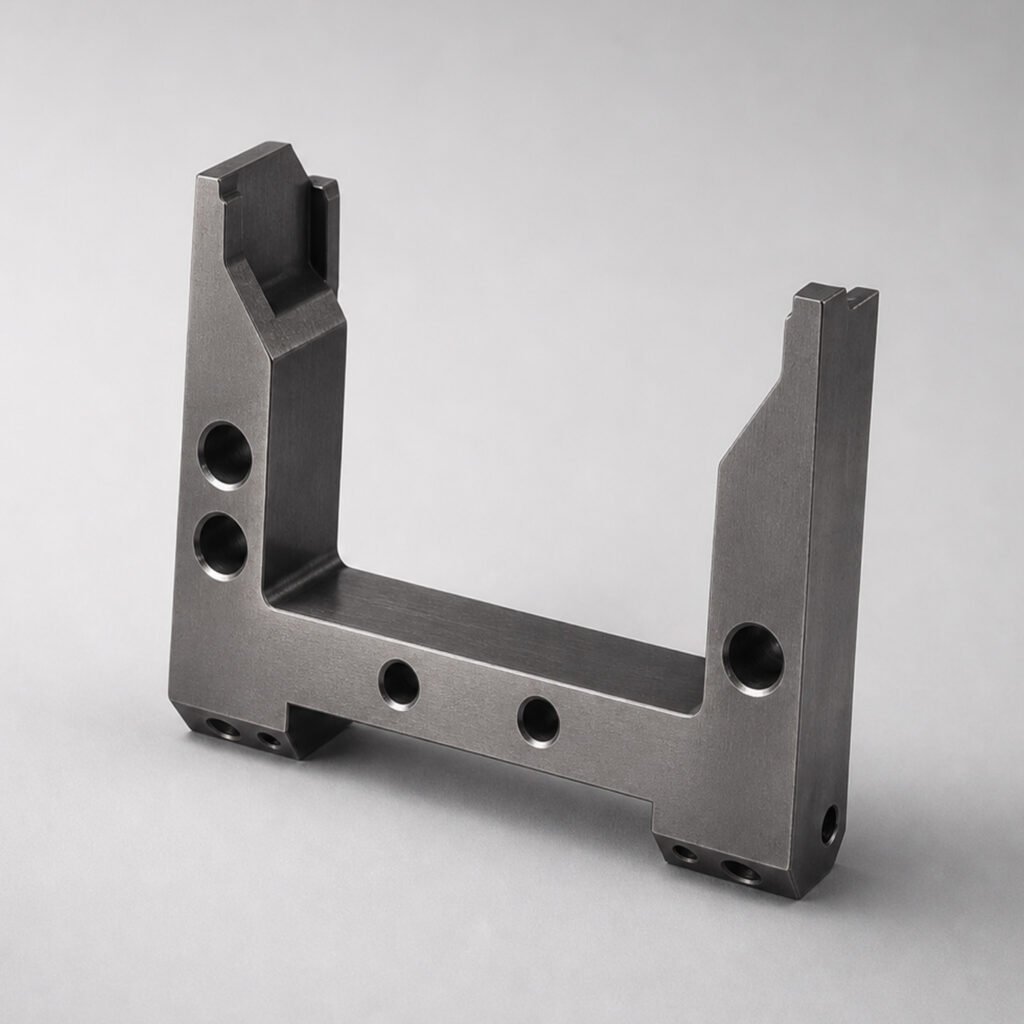
Illustrative reference only — not certified material documentation or dimensional inspection records.
1. Why Engineers Choose 1.1730 / C45U Tool Steel
- Excellent machinability: Cuts smoothly in the annealed or normalized condition with good tool life
- Cost-effective: Lower material and machining costs compared to alloy tool steels
- Simple heat treatment: Water or oil quenching achieves working hardness without complex processing
- Suitable for low-to-moderate duty applications: Mold frames, fixtures, jigs, simple dies, and tooling components
| Scenario | Description |
|---|---|
| Low-to-moderate duty tooling | Fixtures, jigs, mold frames, support plates |
| No high wear resistance required | Non-production or low-wear environments |
| Cost-sensitive projects | Material and machining costs need to be controlled |
| Limited heat treatment capability | Water or oil quenching is sufficient |
⚠️ Important: 1.1730 / C45U is not suitable for stamping cutting edges (punches, die blades, or shearing tools). Its shallow hardened layer will chip quickly under stamping shear loads. For cutting applications, consider D2 / 1.2379 or 1.2601 / X165CrMoV12 instead. See our full tool steel selection guide: D2 vs 1.2601 vs 1.1730: Which Tool Steel Is Right for Your Stamping Application?
2. Key Material Parameters — And Why They Matter
| Parameter | Description | Why It Matters |
|---|---|---|
| Material designation | 1.1730 (EN) / S45C (JIS) / 1045 (AISI) — comparison family | Prevents purchasing or heat-treatment substitution errors |
| Material family | Non-alloy cold-work tool and mold-base steel | Sets expected machining, strength, corrosion, and finishing behavior |
| Supply condition | Annealed, normalized, prehardened, tempered, solution-treated, cold-worked, or polymer grade as applicable | The same nominal alloy can machine and perform differently in another condition |
| Critical processes | Heat treatment, case hardening, coating, anodizing, passivation, or stress relief | Final properties and dimensions often depend on downstream processing |
| Certification | Material certificate, traceability, hardness, chemistry, or inspection-report needs | Avoids discovering documentation requirements after machining |
3. CNC Machining Characteristics and Boundaries
Features that require deliberate process planning
| Feature | Planning Considerations |
|---|---|
| Thin walls and long sections | Plan clamping, roughing, stress relief, and finish allowances |
| Threads and small holes | Define usable depth, edge distance, burr condition, and post-process inspection |
| Sealing and bearing features | Identify final hardness or coating condition and whether grinding, honing, or lapping is required |
| Pockets, slots, and internal corners | Provide realistic radii, tool access, and chip-evacuation space |
Do not treat these risks as optional
- Limited hardenability — not suitable for thick sections requiring uniform hardness
- Lower wear resistance than alloy tool steels — not suitable for high-wear, long-life tooling
- No corrosion resistance without protection — requires black oxide, coating, or oiling
- Not ideal for long-life high-precision tooling — stability and life may be insufficient under high-load conditions
4. Typical Applications and Precision Parts
Suitable Applications for 1.1730 / C45U
- Tool backing plates
- Mold support plates and mold frames
- Simple dies and fixtures
- Tool holders
- Guides and low-wear inserts
- General workshop tools
Mecore RFQ Experience
Mecore reviews 1.1730 / C45U parts by connecting material condition, geometry, critical tolerances, and downstream processing. For this material, a useful RFQ should identify the functional surfaces, expected service environment, and whether inspection applies before or after heat treatment or finishing.
Industry-Specific Attention Point
Parts for moldmaking may require different certification, cleanliness, fatigue, corrosion, or safety controls from visually similar parts used in general machinery. The application and governing standard must therefore be stated, not inferred from geometry.
5. Material Selection Quick Reference
| Material | Characteristics | Recommended Applications |
|---|---|---|
| 1.1730 / C45U | Low-cost, non-alloy tool steel with excellent machinability | Mold frames, fixtures, jigs, low-to-moderate duty tooling |
| 1045 / C45 | General-purpose medium-carbon structural steel | General mechanical structural components; compare cost and performance as an alternative to 1.1730 |
| A2 Tool Steel | Air-hardening tool steel; good dimensional stability during heat treatment; better toughness than D2; moderate wear resistance | Complex-shape dies, punches, tooling where impact resistance and dimensional stability are priorities |
| D2 Tool Steel | High-carbon, high-chromium tool steel; excellent abrasive wear resistance; long edge life | High-load stamping dies, fine blanking dies, cold extrusion dies, high-wear tooling |
6. Processing and Design Pitfalls
| Common Pitfall | Potential Result | Practical Response |
|---|---|---|
| Limited hardenability | Insufficient core hardness, distortion | Confirm condition and process sequence before quotation |
| Lower wear resistance than alloy tool steels | Dimensional changes, short tool life | Add finishing allowance and define the final inspection stage |
| No corrosion resistance without protection | Surface rust, assembly issues | Use stable workholding, sharp tools, and a planned rough/finish strategy |
| Not ideal for long-life high-precision tooling | Insufficient stability and life | Validate service environment, coating, and compatible mating materials |
7. Design-for-Manufacturing Checklist
☐ Specify 1.1730 (EN) / S45C (JIS) / 1045 (AISI) comparison family and the required supply condition
☐ Identify datums and limit tight tolerances to functional features
☐ State heat treatment, coating, passivation, anodizing, or stress-relief sequence
☐ Clarify whether dimensions apply before or after secondary processing
☐ Define hardness, case depth, roughness, flatness, and inspection points where relevant
☐ Mark cosmetic or sealing surfaces and permitted tool, rack, or clamp marks
☐ State certificate, traceability, cleanliness, packaging, and regulatory requirements
8. RFQ Guide
To help Mecore provide you with an accurate quote quickly, the following information is useful:
Basic Information
- 3D CAD file (e.g., STEP format) and a controlled 2D PDF drawing with tolerances
- Material designation: 1.1730 (EN) / S45C (JIS) / 1045 (AISI) including condition or grade
- Prototype and production quantities, plus repeat-order expectations
Technical Requirements
- Critical datums, GD&T, fits, threads, flatness, and surface roughness
- Heat treatment, surface treatment, coating, masking, and post-process dimensions
- Hardness reports, material certificates, or inspection requirements
Logistics Requirements
- Cleaning, protective packaging, labeling, and delivery requirements
References
- ISO 683-1:2016 — Heat-treatable steels, alloy steels and free-cutting steels — Part 1: Non-alloy steels for quenching and tempering
- Lucefin Group — C45U (1.1730) Technical Data Sheet, UNI EN ISO 4957:2002
- Meusburger — 1.1730 Tool Steel Material Grade Specification
- HASCO — 1.1730 / C45U Mould Steel Material Data Sheet
- ArcelorMittal — C45 / C45U (1.1730) Steel Grade Technical Document
- Hasçelik — C45 Steel (SAE / AISI 1045) Material Properties Guide
Editorial Note
This article serves purely as educational reference and does not constitute official material specification or binding engineering documentation. All material performance data, machining process recommendations and product capability statements must be validated by Mecore’s engineering team against your unique project requirements before mass production commences.
Need a quote or engineering review for your 1.1730 / C45U parts?
Send your drawings to our team — we’ll get back to you within 24 hours with a competitive quote and manufacturability feedback.